This article has been written in 2018 for a publication project that never happened and published on this website in 2026. It can be downloaded as a Pdf.
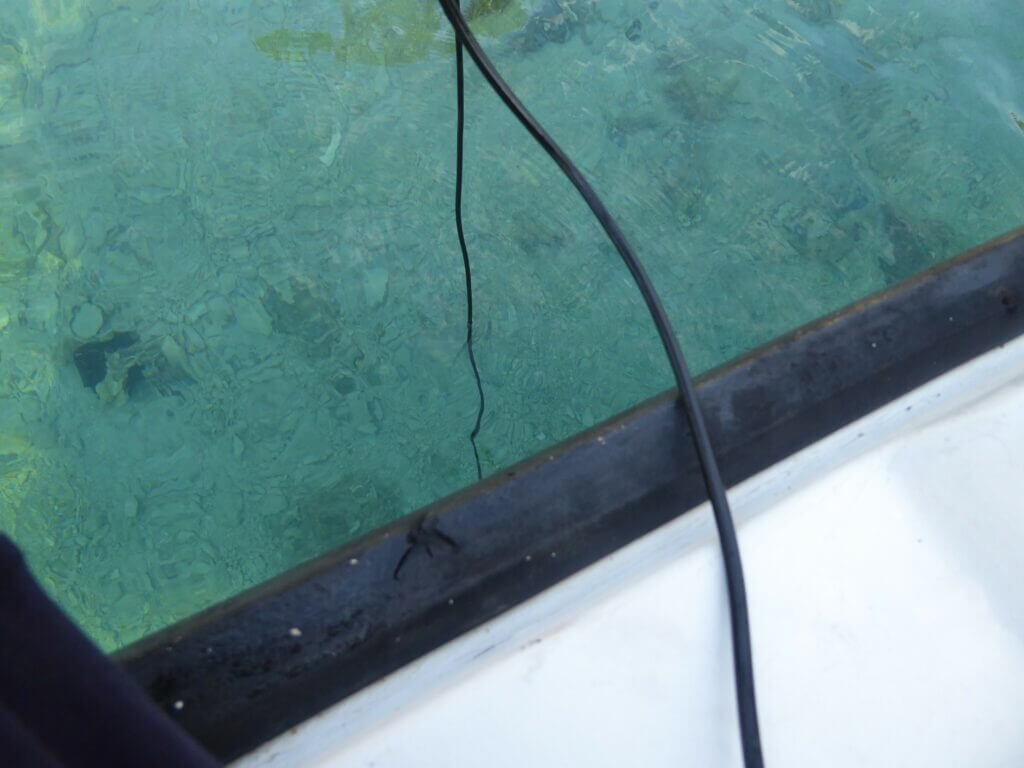
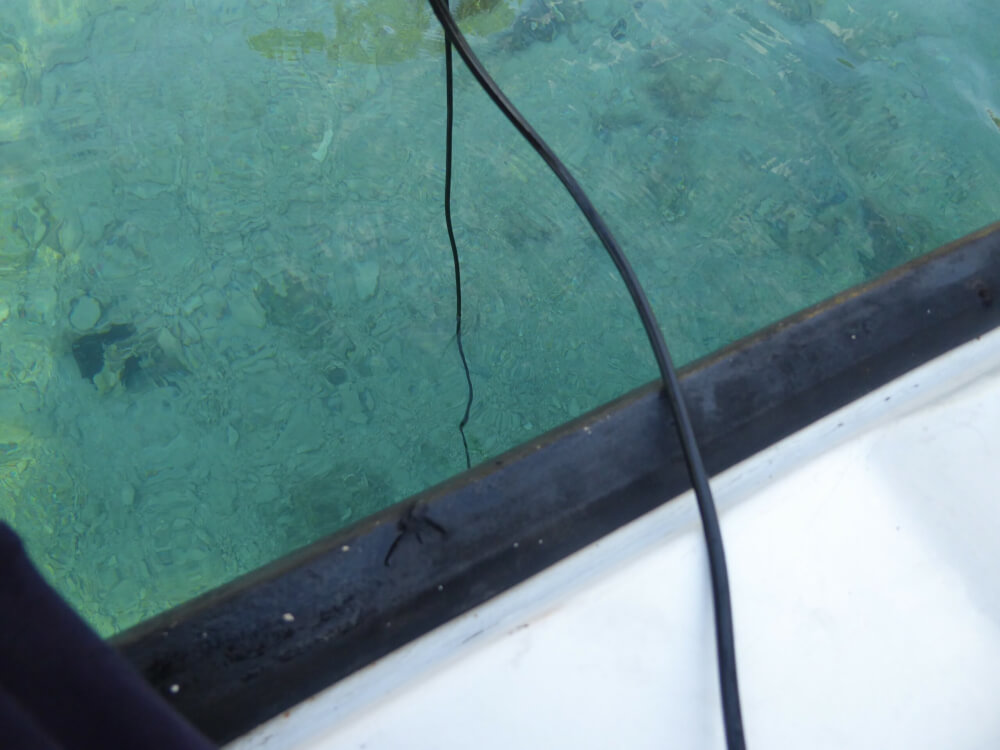
The adriatic sea off shore the island of Korčula on a Summer day, late afternoon: sea and sky are competing for blueness, in the background, the vegetation of the island is dark green, air and light are soft to the bodies. It sounds like a caricature of a perfect day at the seaside. Sounds? The line that goes into the water is not for fishing octopuses but cables an hydrophone. If above the surface it feels quiet and peaceful, below is a thunderstorm of heavy sounds coming from boats and other mechanical engines that resonate into the headphones.
Aquatocene/Subaquatic Quest for Serenity
Aquatocene/Subaquatic Quest for Serenity is a sound piece and audiovisual performance by Robertina Sebjanič based on a series of field recordings in the coastal waters of Izmir, Dubrovnik, Koper, Bergen, Roscoff and Korčula. When listening to it without knowing, or putting aside the knowledge of where the sounds are coming from, it is a beautiful composition of electronic music, almost peaceful and meditative, with bursts of dramatic events, scraping and grating popping up like fire sparkles, wrapped around a basis of deep background noise. Belonging to a genre of established noise music, Aquatocene sounds pleasant to our ears. I would argue that we like it also because it reminds us of the familiar urban background sound that surrounds us like a protective cocoon. As scarry as it may seem, it is silence, or more precisely the non altered sound of nature, that has become frightening. This may be one of the reasons why we are pouring noise everywhere, including to entertain tourists with music on beaches and through various mechanical engines for fun and nautical sports. Aquatocene carries this stunning confrontation between serenity and apocalyptic cacophony felt that day near Korčula.
Subaquatic space as extreme environment
Suaquatic space is an extreme environment* for us, humans. We cannot survive there with our sole « naked » bodies and if we have started inhabiting underwater seas and oceans it is only thanks to our technological enhancements, the « life support system » of a diving suit, of a submarine or a diving platform.
Listening to Aquatocene, knowing that the « dramatic bursts » and « deep background sound » are actual recordings of our activities, is a brutal understanding that our presence above and underseas is even more important than we could have thought and how noisy and disturbing we can be. These are nothing but sound pollution turning the oceans into extreme environments for its native inhabitants.
Aquatocene or the Age of Water: an invitation to re-inhabit the World
Robertina Sebjanič coined the term « aquatocene » as the title of this sound piece. « Aquatocene » means the « age of water ». What would an « age of water » truly be?
Obviously, the first thing that comes to mind is the Flood. The mythical Flood of the Bible or Gilgamesh and other similar stories shared by so many civilisations that have turned an old disaster into tales that we are still telling today. Closer to us, it is the potential future Flood that we may encounter with the rising of the sea level due to climage change and melting of the ice caps.
In a era that is multiplying exclusion zones, more than an unavoidable catastrophy or a substitution, I understand this « age of water » that Sebjanič is highlighting as a proposal for inclusions: the inclusion of the oceans into our global understanding of the « world » and the inclusion of the perspectives of the Others, of the sea creatures’s point of views, or more appropriatly, of their « point of being ».
There is an increased awareness of oceans plastic and oil pollution, less of sound pollution. More and more people are shocked if someone throws a plastic bag or a can into the waters, how many are understanding jet skis and other machines not as « fun » and « entertaining » but as polluting? For most of us, the oceans are still « The Silent World » of Jacques-Yves Cousteau 1956 film. We haven’t fully realised yet that not only are we creating a roaring environment for the sea creatures but that it prevents them to listen to their mates and to communicate with one another. We need to shut up and learn to listen to shrimps or sea urchins like we listen to crickets and birds and to discover that they can be as talkative and enjoyable beings as their land cousins.
As terrestrial mammals, we tend to equal « nature » with « land ». We speak of landscape and the call the underwater sound recordings of the noise pollution that Robertina Sebjanič did fieldrecordings. Aquatocene is a plea to include the seas and oceans in our « nature », a plea for the need to make the world re-inhabitable, for everyone.
* I refer to the following definition of extreme environment: An environment is considered extreme when « one or more parameters show values permanently close to the lower of upper limits known for life ». From the 2007 report Investing Life in Extreme Environments, A European Perspective by the European Science Foundation.
Annick Bureaud, Paris, March 2018
This article has been written for a publication project that never occured. I decided to publish it in June 2026 on my website.